Cimitero delle Fontanelle: Naples’ Most Haunting Hidden Gem
Hidden inside the Rione Sanità, one of Naples’ most fascinating and historic neighbourhoods, there is a place that feels suspended between life and death, faith and superstition, history and legend.
This is the Cimitero delle Fontanelle, also known as the Fontanelle Cemetery: a vast ossuary carved into an ancient tuff cave, filled with thousands of human skulls and bones.
After years of closure, the Cimitero delle Fontanelle has finally reopened to the public, making it once again one of the most unique places to visit in Naples. The official reopening took place in April 2026, with the site returning to regular public access from 19 April 2026.
But this is not just a cemetery.
It is one of the most powerful places to understand Naples’ relationship with death, devotion, poverty, memory, and the invisible world of the souls in Purgatory.
What Is the Cimitero delle Fontanelle?
The Cimitero delle Fontanelle is an ancient ossuary located in Via Fontanelle 80, in the Rione Sanità district of Naples. The site was originally a tuff quarry carved into the Materdei hill. Its name, “Fontanelle”, comes from the small water springs that once flowed from the surrounding hills.
Over time, the quarry became a place where the remains of people without a proper burial were gathered. The ossuary has preserved human remains for at least four centuries, including those of people who could not afford an individual burial and victims of epidemics that struck Naples in the past.
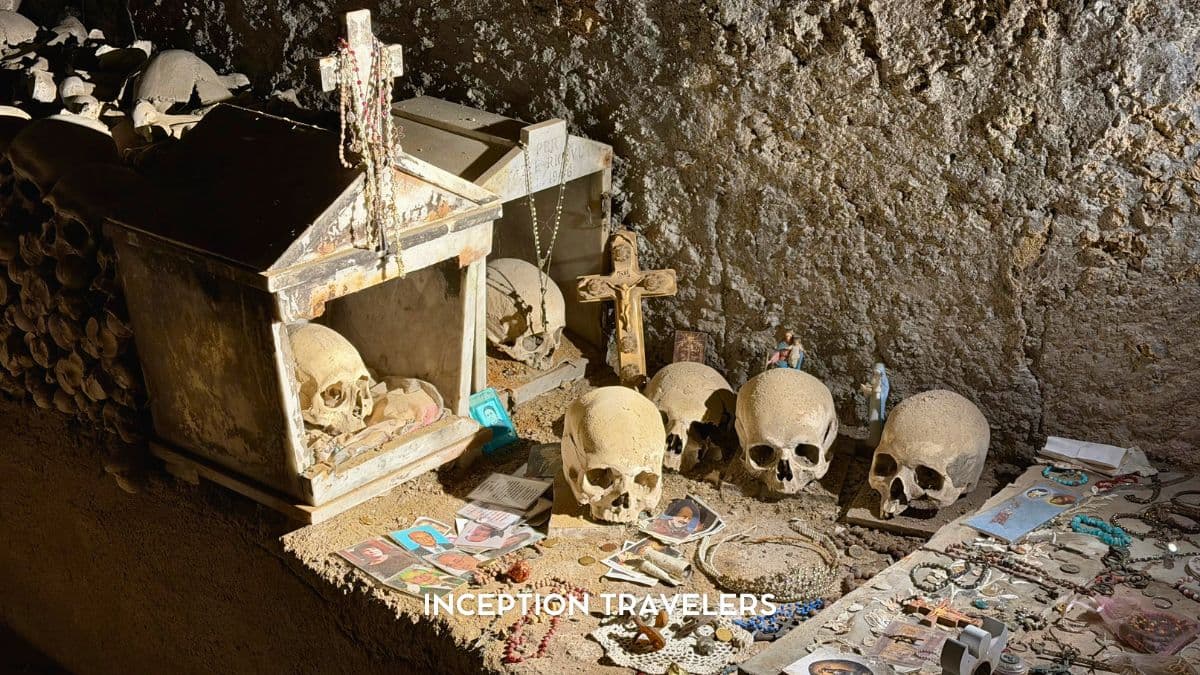
Today, visitors walk through enormous cave-like spaces filled with skulls, bones, candles, small shrines, and memories of a deeply Neapolitan tradition.
It is eerie, yes. But it is also deeply human.
Where Do the Skulls Come From?
The bones inside the Fontanelle Cemetery come from different moments in Naples’ history.
Many belonged to poor people who could not afford a dignified burial. Others are traditionally associated with victims of major epidemics, especially the plague of 1656 and the cholera outbreak of 1836. The site is often said to contain around 40,000 remains, although popular tradition sometimes suggests the number may be much higher.
Naples was historically a very dense city, with limited burial space. Churches, cemeteries, crypts, and underground spaces were often overcrowded. When burial sites were reorganised, many anonymous remains were moved to places like Fontanelle.
This is why the cemetery does not look like a traditional cemetery with graves and names.
Instead, it is an ossuary of the anonymous dead.
Thousands of skulls without names.
Thousands of lives without individual tombs.
Thousands of souls remembered by a city that has always had a special relationship with the afterlife.
The Tradition of the Anime Pezzentelle
The most fascinating part of the Cimitero delle Fontanelle is the tradition of the anime pezzentelle, which roughly means “poor souls”.
In Neapolitan popular devotion, these were souls in Purgatory: abandoned, forgotten, or without anyone to pray for them. The idea was that these souls needed prayers from the living to find peace and move closer to Paradise.
In return, the souls could protect the living, offer guidance, grant favours, or even appear in dreams.
This belief created one of the most unusual traditions in Naples: the adoption of skulls.
A person would choose a skull, known in Neapolitan as a capuzzella, and begin to care for it. They might clean it, place it in a small shrine or box, bring flowers, light candles, pray for it, and ask the soul for help in return.
This was not seen as something macabre by the people who practised it.
It was an exchange of care.
The living prayed for the dead.
The dead protected the living.
What Does “Adopting a Skull” Mean?
To modern visitors, the idea of “adopting a skull” may sound shocking. But in Naples, this tradition was part of a broader spiritual worldview where the boundary between the living and the dead was not completely closed.
The skull represented an abandoned soul. By caring for it, the devotee gave dignity to someone who had been forgotten.
People often asked their adopted soul for protection, healing, luck, or even numbers to play in the lottery. According to popular belief, the soul could appear in dreams and communicate messages to the person who cared for it.
This cult of the capuzzelle became deeply rooted in Neapolitan popular culture. However, in 1969, the Catholic Church officially prohibited the practice, considering it too close to pagan ritual and superstition.
Even though the formal practice was stopped, the memory of the anime pezzentelle remains one of the most important parts of the Fontanelle Cemetery’s identity.
Don Gaetano Barbati and the Reorganisation of the Bones
The devotion to the skulls became especially important at the end of the 19th century.
According to the official history of the site, the anonymous bones were reorganised by Don Gaetano Barbati, helped by women from the local neighbourhood.
This detail is important because it shows how strongly the Fontanelle Cemetery is connected to the local community, especially the people of Rione Sanità.
The cemetery was not only a place of death. It became a place of care, devotion, and neighbourhood identity.
Women played a central role in maintaining the cult of the souls, looking after the skulls, praying, and preserving the memory of the dead.
Why Is the Cimitero delle Fontanelle So Important?
The Cimitero delle Fontanelle is important because it tells a story that is deeply connected to Naples.
Naples has always had a unique relationship with death. In this city, death is not hidden away. It is part of daily life, popular sayings, religious devotion, theatre, art, humour, and superstition.
The Fontanelle Cemetery brings all of this together.
It reflects:
- the poverty of past centuries;
- the impact of epidemics;
- the overcrowding of historic Naples;
- popular Catholic devotion;
- belief in Purgatory;
- the power of dreams and superstition;
- the strong link between neighbourhoods and sacred places;
- the Neapolitan ability to transform tragedy into ritual.
This is why visiting the Cimitero delle Fontanelle is not simply about seeing skulls.
It is about understanding Naples.
The Reopening of the Cimitero delle Fontanelle
The Cimitero delle Fontanelle officially reopened in April 2026 after years of closure. The reopening was presented as a symbolic moment for Naples and especially for the Rione Sanità community. The inauguration took place on 18 April 2026 with a community march starting from Largo Totò, and the site opened regularly from 19 April 2026.
The reopening is part of a public-private partnership between the Municipality of Naples and Cooperativa La Paranza, the same cooperative known for its work in the cultural regeneration of Rione Sanità.
This is significant because Rione Sanità has become one of the most interesting areas of Naples for travellers who want to go beyond the classic tourist routes.
The reopening of the cemetery is not just a tourism update. It is part of a wider cultural rebirth of the neighbourhood.
Visiting the Cimitero delle Fontanelle: Practical Information
The Cimitero delle Fontanelle is now open to visitors, but access is regulated.
According to the official website, the cemetery is open Monday to Sunday from 10:00 am to 6:00 pm, with last admission at 5:15 pm. It is closed on Wednesdays and on Christmas Day.
On Mondays and Fridays, the cemetery is also accessible for worship in the dedicated prayer area from 9:00 am to 10:00 am.
Address
Cimitero delle Fontanelle
Via Fontanelle, 80
80136 Naples, Italy
Nearest metro station
The closest metro stop is Materdei, on Metro Line 1. From Materdei station, it is about a 10-minute walk to the cemetery.
Tickets and Booking
Booking is mandatory to visit the Cimitero delle Fontanelle. Access is organised in small groups entering every 15 minutes, with a maximum of 25 people per group and a maximum visit duration of 40 minutes.
The official website lists different visit experiences, including accompanied tours with an audio guide and guided tours. The official visitor information confirms that booking must be made online.
Ticket prices can vary depending on the type of visit. Several local sources report prices starting from around €6 for accompanied visits and €8 for guided visits, while some options or third-party guided experiences may reach around €10 per person. Always check the official website before visiting, as prices and availability may change.
Important: book through the official Cimitero delle Fontanelle website to avoid confusion with unofficial tour pages.
How Long Does the Visit Take?
The visit lasts around 40 minutes, according to the official visitor rules.
This is enough time to walk through the main spaces, understand the atmosphere, and learn about the history of the ossuary and the cult of the anime pezzentelle.
However, if you are visiting Rione Sanità, we recommend planning at least half a day in the area. You can combine the Fontanelle Cemetery with other nearby places such as:
- Catacombs of San Gennaro;
- Catacombs of San Gaudioso;
- Basilica di Santa Maria della Sanità;
- Palazzo dello Spagnolo;
- Palazzo Sanfelice;
- Jago Museum;
- local food stops in Rione Sanità.
The official website also mentions that visitors can continue exploring the district through the Rione Sanità cultural network.
Is the Cimitero delle Fontanelle Scary?
It depends on what you mean by scary.
If you expect horror-movie vibes, that is not really the point of the place. The cemetery is certainly haunting, but it is also quiet, spiritual, and deeply emotional.
The skulls are real. The bones are real. The atmosphere is powerful.
But the Cimitero delle Fontanelle is not designed to shock visitors. It is a sacred and historic place connected to grief, memory, devotion, and Neapolitan identity.
You should visit with respect.
Do not treat it like a Halloween attraction.
Do not touch the bones.
Do not use flash in a disrespectful way.
Do not turn someone else’s remains into a joke.
The beauty of this place is not in the fact that it is “creepy”.
It is in the fact that Naples turned anonymous death into memory.
Best Time to Visit
The best time to visit is usually in the morning or early afternoon, especially if you want to explore Rione Sanità afterwards.
Since visits are regulated and booking is mandatory, the most important thing is not the time of day but securing your ticket in advance.
If you are filming or taking photos for travel content, check the current photography rules before visiting. The site is a sacred and sensitive place, so content should be respectful.
What to Wear and What to Know Before Visiting
The Cimitero delle Fontanelle is inside a cave-like space, so it can feel cooler than the streets outside. Comfortable shoes are recommended, especially because the surrounding area includes slopes and uneven streets.
Before visiting, remember:
- book online in advance;
- arrive on time for your slot;
- expect a 40-minute visit;
- wear comfortable shoes;
- behave respectfully;
- do not touch the remains;
- check official rules before filming;
- combine it with Rione Sanità for a richer experience.
Why You Should Visit the Fontanelle Cemetery in Naples
The Cimitero delle Fontanelle is one of the most unforgettable places in Naples.
It is not as famous as Pompeii, the Royal Palace, or Spaccanapoli, but it reveals something incredibly deep about the city.
Naples is a place where history is never just history. It is alive in the streets, in the churches, in the underground tunnels, in the food, in the gestures, in the stories people still tell.
At Fontanelle, even the dead are part of the city’s living memory.
You do not visit this place only to see skulls.
You visit it to understand how Naples deals with death, poverty, faith, superstition, and hope.
And that is what makes it one of the most haunting hidden gems in Italy.
FAQs About the Cimitero delle Fontanelle
Is the Cimitero delle Fontanelle open?
Yes. The Cimitero delle Fontanelle reopened in April 2026 and is now open to visitors with mandatory online booking.
Where is the Cimitero delle Fontanelle?
The cemetery is located at Via Fontanelle 80, in the Rione Sanità district of Naples.
How do you get to the Cimitero delle Fontanelle?
The closest metro station is Materdei on Metro Line 1. From there, it is about a 10-minute walk to the cemetery.
How much does it cost to visit the Cimitero delle Fontanelle?
Prices vary depending on the type of visit. Recent visitor information reports tickets starting from around €6 for accompanied visits and €8 for guided visits, with some options or external guided experiences reaching around €10 per person. Always check the official website before booking.
Do you need to book in advance?
Yes. Booking is mandatory. Access is organised in small groups entering every 15 minutes.
How long does the visit take?
The official visit duration is around 40 minutes.
Why are there so many skulls in the Cimitero delle Fontanelle?
The cemetery contains the remains of people who could not afford a burial, as well as victims of epidemics and remains moved from overcrowded burial sites in Naples.
What are the anime pezzentelle?
The anime pezzentelle are the “poor souls” in Purgatory. In Neapolitan popular devotion, people prayed for these abandoned souls and, in return, believed the souls could offer protection, favours, or guidance.
What does capuzzella mean?
A capuzzella is a skull. In the tradition of the Fontanelle Cemetery, people would “adopt” a skull, care for it, pray for it, and ask the soul connected to it for protection or help.
Is the Cimitero delle Fontanelle worth visiting?
Yes, especially if you are interested in hidden places, local traditions, underground Naples, spiritual history, and unusual cultural sites. It is one of the most unique places to visit in Naples.