After years of dreaming about the Red Island, we finally set off — from 7 August to 9 September 2025 — for a month-long adventure across South–West Madagascar — where rainforests echo with the call of the indri, razor-sharp tsingy rise like stone cathedrals, pirogues glide down wild rivers, and the Mozambique Channel glows at sunset behind ancient baobabs. 🦎🌿🌊
We planned and booked most of this 34-day itinerary entirely by ourselves — from boutique lodges to domestic flights — while getting some local help just for the most logistically complex parts. The amazing team at Tsiky Tour, a tour operator based in Antananarivo, arranged our private 4x4 with driver and secured access to experiences that are otherwise hard or impossible to book on your own, like the Tsiribihina River pirogue descent and guided treks inside Madagascar’s national parks.
In total, including flights, driver, lodges, park entrances, activities and meals, this dream trip cost us around €12,000 — and every cent was worth it. Below you’ll find our complete day-by-day itinerary with logistics, highlights, tips and all the places we stayed.
🗺️ Itinerary Overview
- Antananarivo (Tana)
- Andasibe–Mantadia (Peyreiras, Mitsinjo night walk, Analamazaotra/Indri)
- Antsirabe
- Miandrivazo
- Tsiribihina River Descent (bivouac)
- Bekopaka – Tsingy de Bemaraha (Petit & Grand Tsingy)
- Morondava & Avenue of the Baobabs (sunset & sunrise)
- Belo-sur-Mer
- Andavadoaka (Laguna Blu)
- Ifaty (Mangily) & Toliara area
- Ranohira – Isalo National Park
- Ranomafana National Park
- Antsirabe
- Antananarivo
- Nosy Be (Lokobe, Nosy Iranja, Nosy Tanikely, Nosy Sakatia, Hell-Ville)
🌐 Stay Connected — We used an eSIM to stay online across Madagascar. If you prefer a quick setup, consider Holafly for instant data, then compare with local SIMs in Tana for best value.
⚕️ Travel Health & Safety — Itineraries here cross remote regions. Pack a basic first-aid kit, electrolytes, a headlamp, dry bags, and spare cash. Medical note: Consult a travel clinic ahead of time for malaria prophylaxis and routine vaccinations appropriate for Madagascar.
Day 1: Antananarivo (Arrival) ✈️
Touchdown in Antananarivo, the chaotic and fascinating gateway to Madagascar. After landing, we arranged a private hotel transfer in advance (around €14, paid in cash on arrival), which made things much smoother after a long journey.
The plan for the first evening was simple: slow down, reset, and get ready for the adventure ahead.
We headed out briefly to withdraw cash from an ATM about 10 minutes away — something you’ll quickly realise is essential here. Cash is everything in Madagascar, especially once you leave the capital, so we recommend withdrawing a good amount right away.
That said, Tana doesn’t feel like a city where you’d want to wander aimlessly, especially after dark. We kept things low-key and headed back to the hotel to rest and recharge.
Hotel: Maison Lovasoa
A very simple but authentic stay, perfect for a first night.
- The staff were incredibly kind and welcoming, which made a big difference after a long travel day
- Breakfast was surprisingly good and fresh - a great way to start the next morning
- Rooms are basic, but comfortable enough for a short stay
We didn’t spend much time here beyond resting, but it did exactly what we needed: a calm, safe base before heading into the wild parts of the country.
⚠️ Tips for Your First Day
- Withdraw cash immediately — don’t rely on cards
- Pre-book your airport transfer to avoid hassle
- Take it easy — long travel + new environment hits harder than expected
- Avoid wandering at night, especially on your first day
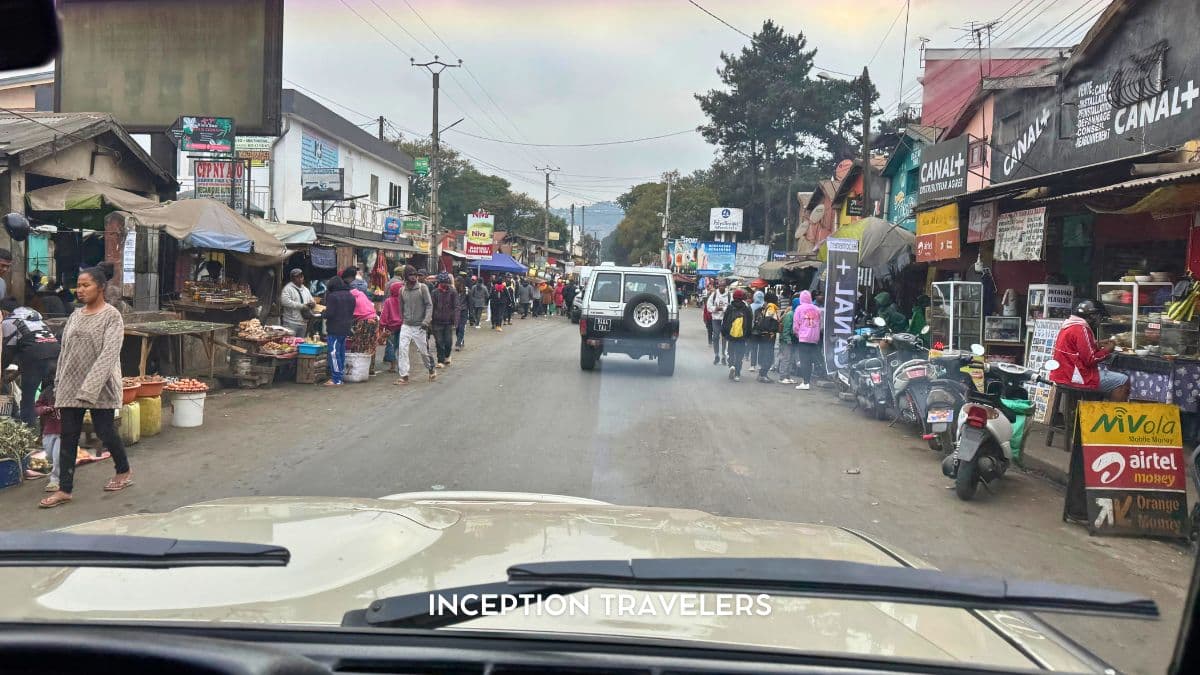
Day 2: Antananarivo → Andasibe (Peyreiras & Night Walk) 🌿
After our first night in Antananarivo, the real adventure finally began.
We met our driver early in the morning — a private 4x4 with an English-speaking driver, which honestly becomes your lifeline in Madagascar — and started heading east, leaving behind the chaos of the capital and slowly entering a completely different world.
The further we drove, the greener everything became.
🦎 First Stop: Peyreiras Reserve
This was our first real encounter with Madagascar’s wildlife, and it did not disappoint.
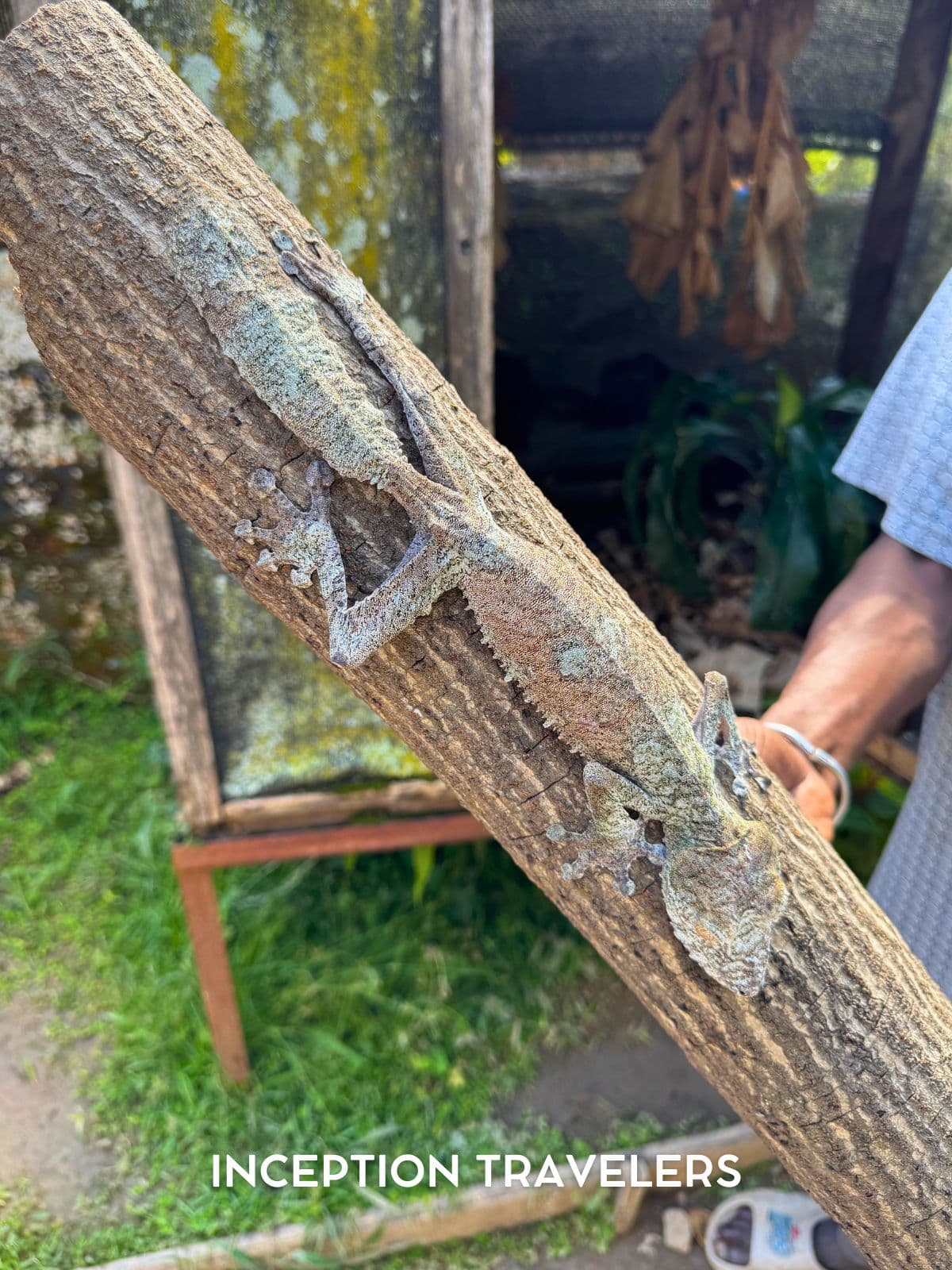
Peyreiras is a small, family-run reserve, but what makes it special is how close and detailed the experience is. Unlike big national parks, here the guides know exactly where to find animals - and suddenly what feels invisible becomes obvious.
Within minutes, we were spotting:
- Tiny chameleons perfectly camouflaged on leaves
- Bright green geckos
- Tree frogs that look straight out of a cartoon
- Butterflies everywhere
What’s crazy is that without a guide, you’d probably see nothing. They literally point at a branch and say “look closer”… and suddenly there’s a chameleon staring right at you.
It’s the perfect introduction to Madagascar’s unique ecosystem - slow, observant, and full of surprises.
🚙 Into the Forest: Arrival in Andasibe
After Peyreiras, we continued driving towards Andasibe, where the landscape shifts into dense rainforest.
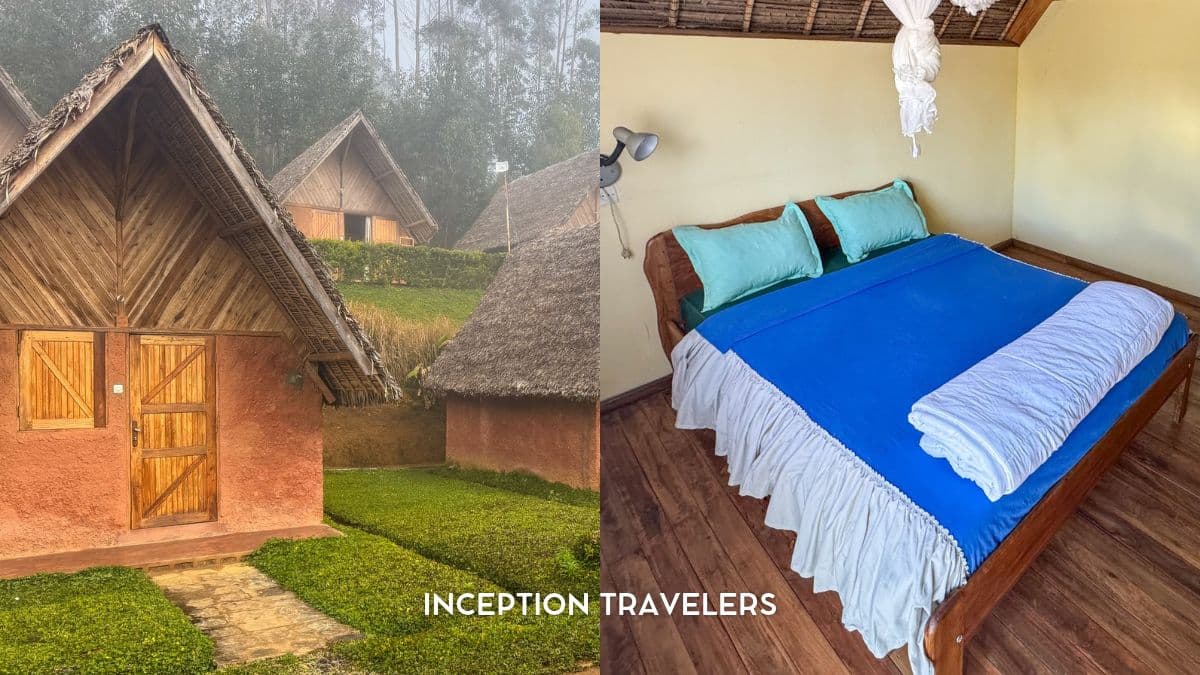
We checked into our hotel near the forest - simple, surrounded by nature, and already you could hear the sounds of the jungle creeping in.
Hotel: Soanala
🌙 Night Walk in Mitsinjo Reserve
After a quick rest, we headed out again - this time into the darkness.
This was one of the most surreal experiences of the trip.
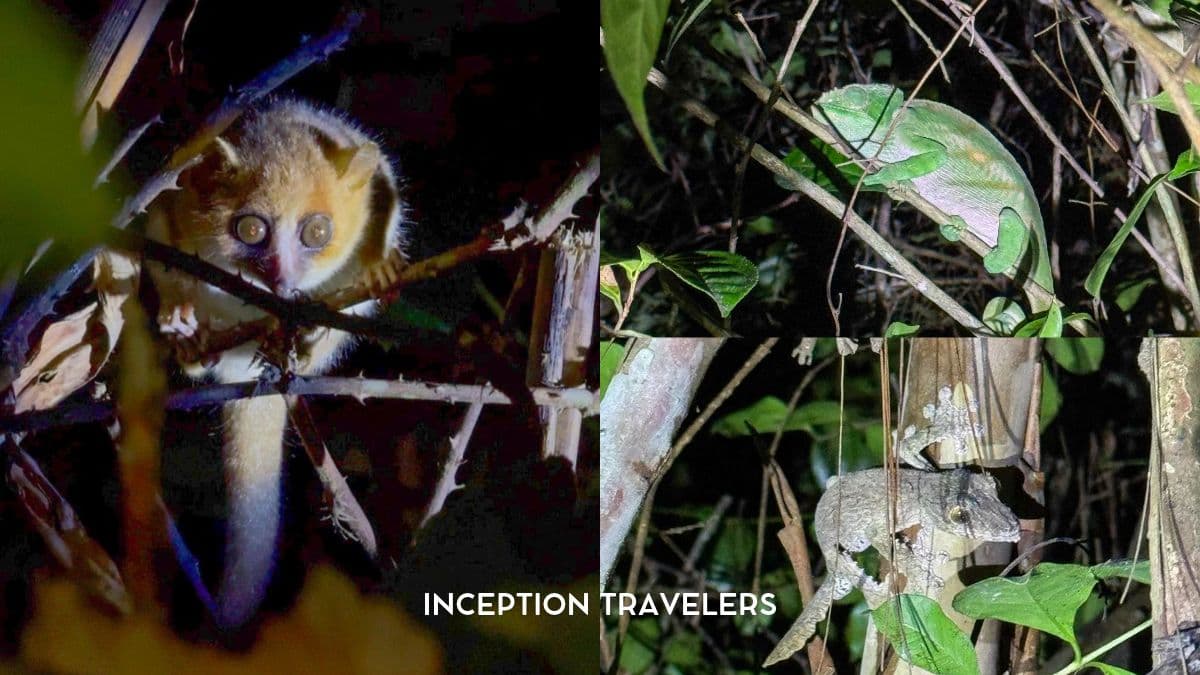
The night walk happens along the roadside and forest edges, where guides scan the trees with torches looking for reflections - tiny glowing eyes hidden in the dark.
And yes… we saw everything:
- The famous mouse lemur - incredibly small and fast
- Sleeping chameleons, easier to spot at night thanks to their pale color
- Bright tree frogs clinging to branches
There are quite a few groups doing this walk, so it’s not a “completely alone in the jungle” vibe - but honestly, it adds to the experience. Everyone is excited, whispering, pointing, sharing sightings.
It feels like a real-life night safari.
⚡ First Real Madagascar Moment
This was the moment it clicked:
You’re in the dark, in the middle of a rainforest, spotting animals you’ve only ever seen in documentaries.
And you realize… this place is completely different from anywhere else.
💡 Tips for This Day
- Trust the guides - they see things you’ll never notice alone
- Bring a headlamp or torch (essential for the night walk)
- Be patient and observant - the magic is in the details
- Don’t expect luxury - expect raw, real experiences
Day 3: Andasibe - Into the Forest with the Indri🐒
Waking up in Andasibe feels different.
You’re not waking up to city noise, but to the sound of the rainforest. Mist hanging between the trees, humidity in the air, and that feeling that something is already moving around you.
After breakfast, we headed into Analamazaotra National Park, the most famous part of Andasibe and home to Madagascar’s most iconic creature.
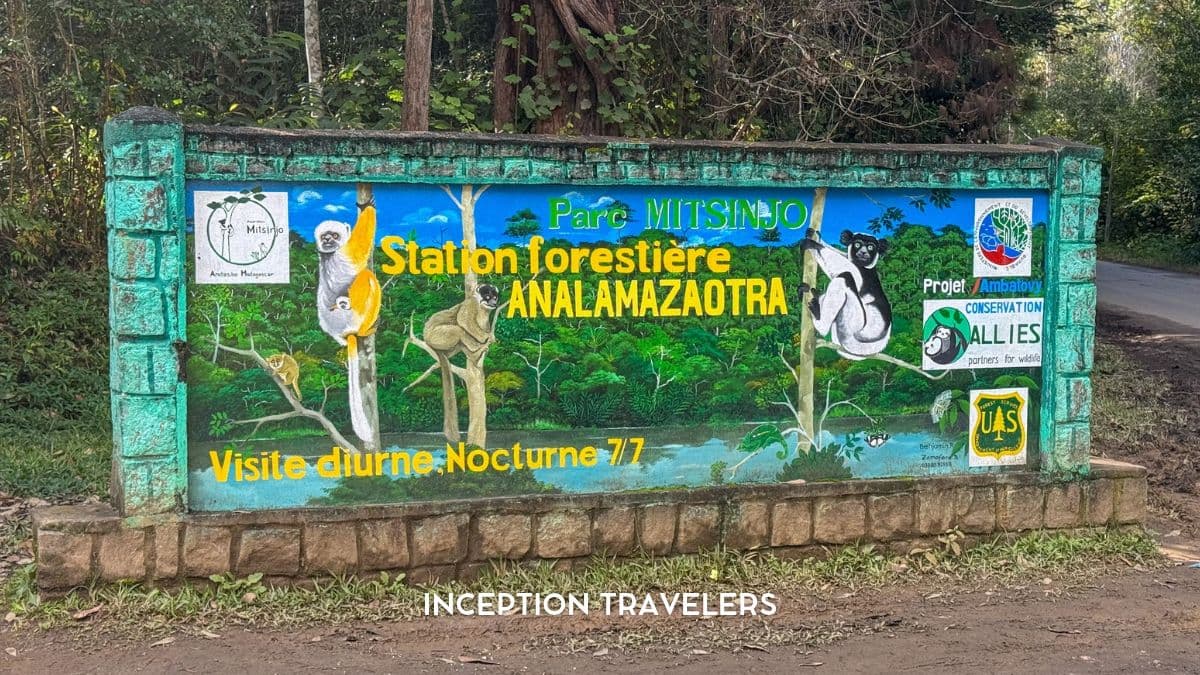
🌿 The Search Begins
The hike starts gently, following muddy forest trails under a dense green canopy. At first, it’s quiet.
You hear insects, birds, leaves moving… but you don’t really see much.
And then suddenly - everything changes.
🔊 The Sound You’ll Never Forget
Before you see them, you hear them.
A loud, haunting, almost prehistoric call echoing through the forest.
That’s the indri indri - the largest living lemur in the world.
And trust us… it gives you chills.
🐒 Meeting the Indri Indri
After following the sound with our guide, we finally spotted them high up in the trees.
Black and white, with no tail, moving gracefully between branches.
And then… they started jumping.
Huge, powerful leaps from tree to tree - way bigger than you’d expect.
We stayed there just watching them, completely silent, while they called to each other across the forest.
It didn’t feel like a zoo.
It felt like we were guests in their world.
🐾 More Wildlife: The Sifaka (the “Dancing Lemur”)
As if that wasn’t enough, we also spotted sifakas - the famous “jumping lemurs”.
These guys move differently.
- On trees: fast, sideways jumps, almost like flying
- On the ground (if you’re lucky to see it): that iconic sideways “dance” walk
They’re lighter, more playful, and honestly… they steal the show.
🌺 The Details That Make It Special
Between the big sightings, there’s so much more if you slow down:
- Tiny chameleons blending perfectly into branches
- Unique orchids growing wild in the forest
- Rare endemic birds you won’t see anywhere else on Earth
This isn’t a “rush to see animals” experience.
It’s about being fully present in the forest.
⚡ One of the Highlights of Madagascar
Seeing the indri in the wild is something you don’t forget.
No cages.
No barriers.
Just you… and the rainforest.
Hotel: Soanala
💡 Tips for This Day
- Go early in the morning - best time to hear and find the indri
- Listen before looking - the sound leads you to them
- Wear proper shoes (muddy trails!)
- Don’t rush - the magic is in staying still and observing
Day 4: From Rainforest to Highlands — Andasibe → Antsirabe
Leaving Andasibe felt like saying goodbye to the jungle.
The sounds fade, the air becomes drier, and slowly the dense green rainforest gives way to open landscapes, rice fields, and highland villages.
This is one of those days where Madagascar really shows how diverse it is.
🚙 The Journey Itself
The drive is long - but never boring.
You pass through:
- Endless rice terraces carved into the hills
- Small roadside villages with kids waving as you pass
- Local markets, zebu carts, and daily life unfolding in real time
It’s not a “scenic drive” in the classic sense, it’s more like watching Madagascar live, kilometer after kilometer.
🌄 Arrival in Antsirabe
By the time you reach Antsirabe, everything feels different again.
- The air is cooler and fresher
- The city has a calm, almost colonial vibe
- Wide streets, old buildings, and a slower rhythm of life
It’s known as Madagascar’s “thermal city” and feels much more relaxed compared to Tana.
🎨 A Note on Workshops
Antsirabe is famous for its local artisan workshops - from miniature objects made out of recycled materials to traditional crafts.
👉 Just one thing to keep in mind:
many workshops are closed on Sundays, so plan accordingly if you want to visit them.
🏡 Where We Stayed: L’Anis Etoilé
A really nice surprise after a long drive.
- Cozy atmosphere, surrounded by greenery
- Quiet and peaceful — perfect to recharge
- A step up in comfort compared to previous stays
This felt like a proper break in the middle of the journey, before heading into more remote areas.
Hotel: L’Anis Etoilé
⚡ A Different Side of Madagascar
This day is not about wildlife or big highlights.
It’s about contrast.
From humid rainforest to cool highlands,
from wild nature to small-town life.
And it reminds you that Madagascar isn’t just one landscape - it’s many worlds in one island.
💡 Tips for This Day
- Start early - distances take longer than expected
- Keep your camera ready - real life moments happen everywhere
- Plan workshop visits around the day of the week
- Use this day to rest and reset
🚙 Day 5: Into the Wild — Antsirabe → Miandrivazo
We left the cool highlands of Antsirabe early in the morning, not fully realising that this would be the day where Madagascar starts to feel raw, remote, and untamed.
The destination: Miandrivazo - the starting point of one of the most unique experiences of the entire trip.
🌡️ The Landscape Changes… Again
As you drive west, everything shifts.
- The air becomes hotter and heavier
- The green highlands slowly disappear
- The landscape turns drier, dustier, more rugged
You start seeing fewer towns, fewer tourists… and more of the real Madagascar.
By the time we got closer to Miandrivazo, it genuinely felt like we were heading into the middle of nowhere.
🛣️ Not Just a Transfer Day
On paper, this is just a “transfer day”.
In reality, it’s the moment you realise:
👉 You’re about to leave comfort behind
👉 You’re heading somewhere with very little infrastructure
👉 And the next few days will be something completely different
This is the calm before the adventure.
🏜️ Arrival in Miandrivazo
Miandrivazo is not a place you visit for beauty.
It’s hot, dusty, chaotic - but that’s exactly what makes it feel authentic.
This is the true gateway to the Tsiribihina River, where travelers, guides, and pirogue teams all pass through before disappearing into the wilderness.
You can feel it in the atmosphere, everyone here is either coming from or going into an adventure.
🏡 Where We Stayed: Princesse Tsiribihina
A very basic but functional stay, and honestly, that’s all you need here.
- Simple rooms
- No luxury, but everything works
- A place to rest before the river journey begins
You’re not here for the hotel - you’re here for what comes next.
Hotel: Princesse Tsiribihina
⚡ The Turning Point of the Trip
This is the day the trip changes.
Up until now, you’ve been exploring.
From here on… you’re adventuring.
💡 Tips for This Day
- Prepare mentally for basic conditions from now on
- Charge everything - power won’t always be available later
- Pack your essentials ready for the next day (river descent!)
- Stay hydrated - it gets very hot here
🛶 Day 6: Drifting into the Wild - Tsiribihina River Descent
This is the day everything slows down.
No more roads.
No more cars.
No more signal.
Just the river.
We left Miandrivazo in the morning and reached the starting point of the Tsiribihina River, where our pirogue was waiting.
A long wooden boat.
A small crew.
And days of nothing but nature ahead.
🌊 Life on the River
As soon as you start moving, you feel it:
Everything becomes quiet, slow, and real.
You’re drifting between:
- Massive cliffs and deep gorges
- Endless stretches of untouched nature
- Occasional baobabs rising in the distance
No engines, no rush - just the sound of water and the paddle cutting through it.
🐊 Wildlife Encounters (Yes… Crocodiles)
This isn’t a “maybe you’ll see something” kind of place.
It’s wild.
We spotted:
- Birds flying low over the water
- Lemurs moving along the riverbanks
- And yes… crocodiles, resting silently near the shore
Not close enough to be scary - but close enough to remind you where you are.
💦 Stop at Anosinampela Waterfall
One of the best moments of the day.
We stopped at Anosinampela Waterfall, hidden between the cliffs.
A short walk… and suddenly:
- A waterfall dropping into a natural pool
- Lemurs jumping between trees nearby
- That feeling of being in a place that’s still untouched
Cold water, fresh air, and pure silence.
🍛 Life with the Crew
One of the most unexpected parts of this experience?
The crew.
This whole journey is only possible through a local tour operator - they handle everything, from logistics to food to safety - and honestly, they make the experience what it is.
And the food? Unreal.
They cooked for us right there on the river:
- Cantonese-style rice
- Zebu meat
- Freshly prepared meals at every stop
They also took care of everything:
- Setting up shade with umbrellas
- Preparing lunch stops
- Organising the entire bivouac
You don’t have to think about anything - just experience it.
🏡 A Stop in a Remote Village
At one point, we stopped in a small riverside village while the guide went to buy supplies for the next day.
Kids came running to meet us.
Smiling, curious, full of energy.
No tourism setup, no performances, just a real, spontaneous interaction.
Moments like this stay with you.
🌌 Night Under the Stars (Bivouac)
As the sun started setting, we reached a sandbank in the middle of the river.
This would be home for the night.
The crew set everything up:
- Tents
- Cooking area
- Dinner under the open sky
And then… darkness.
No lights.
No noise.
Just a sky completely filled with stars.
You lie in your tent, hearing the river flow, knowing there’s nothing around you for kilometers.
It’s peaceful.
A bit surreal.
And unforgettable.
⚡ A Once-in-a-Lifetime Experience
This isn’t luxury.
It’s not polished.
It’s raw, simple, and real.
And that’s exactly why it’s one of the best experiences in Madagascar.
💡 Tips for This Day
- Bring a dry bag - everything is exposed to water
- Pack light, but smart (headlamp is essential)
- Be open to local food - it’s part of the experience
- Don’t expect WiFi, signal, or comfort - expect adventure
🌊 Day 7: Slowing Down - Tsiribihina River (Bivouac Night 2)
You wake up in your tent… and for a second, you forget where you are.
Then you hear it. The river.
Soft, constant, endless.
No alarms, no noise - just nature.
☀️ Morning on the River
We started the day slowly.
- Simple breakfast prepared by the crew
- Packing up the camp
- Back onto the pirogue as the sun started rising
And just like that… we were drifting again along the Tsiribihina River.
🛶 The Reality of the Pirogue
Spending a full day on the pirogue is… not as easy as it sounds.
It’s:
- Long
- Hot
- Repetitive
But at the same time… incredibly relaxing.
You don’t do anything.
You don’t think about anything.
You just watch the world pass by.
And after a while, you start appreciating it.
🐊 More Wildlife Along the Banks
This part of the river felt even more remote.
Less people.
More silence.
We spotted:
- More crocodiles, just lying still under the sun
- Birds flying across the water
- The occasional movement in the trees along the banks
There’s something surreal about drifting past wildlife like this — no barriers, no distance.
🍚 Simple Food, Incredible Taste
Lunch was another highlight.
The crew cooked:
- Fresh vegetables and rice
- And honestly… it was so good
But the real surprise?
👉 Bananas with condensed milk
Simple, but one of those things that just hits differently when you’re out there in the middle of nowhere.
🌅 A Day Without Stops
Unlike the first day, this one is more continuous.
No big stops.
No waterfall.
Just hours of slow movement, letting the river carry you deeper into the wild.
It’s the kind of day where nothing “big” happens, but everything feels meaningful.
🌌 Second Night Bivouac
By late afternoon, we reached our next sandbank.
Same setup.
Same simplicity.
But it feels different now - more familiar.
The crew prepared dinner:
- Rice with chicken, freshly cooked
We ate under the open sky again, surrounded by complete silence.
And then… Straight to sleep.
No distractions.
No signal.
Just the river, the stars, and the feeling of being completely disconnected from the world.
⚡ The Beauty of Doing Nothing
This day teaches you something:
You don’t always need constant action.
Sometimes, the best experiences are just about slowing down and being there.
💡 Tips for Day 7
- Bring something to protect from the sun (hat, long sleeves)
- Stay hydrated - it gets very hot
- Embrace the slowness - don’t fight it
- Enjoy the simple food… it’s part of the magic
🚙 Day 8: Back to Reality — River End → Bekopaka
Waking up on the river for the last time felt… strange.
You’ve spent two days completely disconnected, no signal, no roads, no noise - and now it’s time to go back.
One last breakfast.
One last look at the water.
And then… the journey continues.
🛶 End of the Descent - Arrival in Belo sur Tsiribihina
After a final stretch on the Tsiribihina River, we reached Belo-sur-Tsiribihina.
And just like that - the expedition part ends.
Waiting for us on the shore:
👉 Our driver
👉 Our luggage (finally reunited 😅)
👉 And the next phase of the adventure
It felt weird going from total isolation back to seeing people, cars, and movement again.
⛴️ Crossing the River - The Only Way Through
To continue the journey, we had to cross the river.
Not via a bridge.
Not via a road.
👉 A wooden ferry boat.
This is literally the only way to get across - and honestly, it’s such a cool experience.
Cars, people, luggage… everything loaded onto this simple floating platform, slowly moving across the water.
It’s chaotic, slow, and completely authentic.
🍽️ A Well-Earned Lunch at La Riviera
After days of river life, this felt like luxury.
We stopped at La Riviera, a surprisingly modern restaurant for the area — clearly set up for travelers passing through.
- Proper tables
- Clean setting
- Good food
And honestly… we needed it.
After two days in the wild, sitting down for a “normal” meal hits differently.
🚙 The Road to Bekopaka
From here, we continued by 4x4 towards Bekopaka.
The road? Rough. Dusty. Long.
This is Madagascar again — distances look short on the map, but the journey takes time.
🏡 Where We Stayed: Hotel Orchidée du Bemaraha
Alright… let’s be honest 😂
👉 This was the worst hotel of the trip.
- Very basic
- Not the cleanest
- Definitely not comfortable
But at this point, you kind of expect it.
And more importantly — you’re not here for the hotel.
You’re here for what comes next:
👉 The Tsingy.
💡 Tips for This Day
- Enjoy the ferry - it’s part of the experience
- Don’t expect smooth roads (mentally prepare 😂)
- Appreciate the small comforts (like a proper meal!)
- Lower expectations for accommodation in this area
Hotel: Hotel Orchidée du Bemaraha
⛰️ Day 9: Petit Tsingy & Manambolo River
Waking up in Bekopaka, we knew this was the day we’d finally step into the famous stone landscape.
First things first…
👉 Breakfast at the hotel - honestly, not great 😂
But we didn’t care much, we had bigger things ahead.
🪨 Exploring the Petit Tsingy
We started with the Petit Tsingy, the smaller and more accessible version of the Tsingy.
Still, it’s impressive.
- Sharp limestone formations rising everywhere
- Narrow paths between rocks
- A landscape that feels completely different from anything else
It’s not too difficult, but enough to give you a proper introduction to this unique environment.
🕳️ Caves & River Experience
After exploring the Tsingy, we moved on to the caves and the river.
We boarded a pirogue on the Manambolo River, floating between high rock walls and entering small caves carved into the cliffs.
The atmosphere here is very different:
- Quiet
- Shaded
- Almost mysterious
You can also see the Vazimba tombs hidden in the rocks — sacred and untouched.
🐊 More Crocodiles
And yes… again 😂
We spotted more crocodiles along the riverbanks, just resting in the sun.
At this point, you kind of get used to it — but it’s still crazy every time you see one.
💡 Tips for This Day
- Good shoes are enough (no need for anything extreme yet)
- Take your time - it’s not a rush day
- Bring water, it gets hot even in the shade
- Enjoy it as a warm-up
Day 10: Bekopaka — Grand Tsingy (Harnessed Routes) 🧗
Day 9 was the warm-up. This was the real thing.
The Grand Tsingy is the reason most people come all the way to Bemaraha — and about ten minutes in, we understood why.
🪨 What the Tsingy Actually Is
The name gives it away. In Malagasy, tsingy means something close to “where one cannot walk barefoot” — and one look at the rock explains it.
What you're climbing through was once seabed. Limestone built up underwater over an enormous stretch of time, then got pushed up above the water. Monsoon rain has been working on it ever since, running down through every crack in the rock and cutting the plateau into a forest of grey blades and needles — some of them as tall as buildings, every one of them razor-edged along the top.
Underneath all of that there's a second landscape: caves, tunnels and canyons carved out where the water drained away. Plenty of what lives down there lives nowhere else on earth, which is a large part of why the whole massif is protected as a UNESCO World Heritage Site.
🧗 Harnessed, Not Hiked
The Grand Tsingy is not a walk. You're fitted with a harness at the entrance and clipped onto fixed cables for a good part of the route.
The circuit climbs up inside the rock, squeezes through gaps barely wide enough for one person, and then pops out on top of the needles — with the whole spiked landscape opening up around you.
There are caves, ladders, and lookout points where you can see the stone forest running to the horizon.
🌉 The Tibetan Bridge
The best part of the whole park.
A rope suspension bridge strung between two rock towers, with the canyon dropping away underneath you and nothing but needles below.
It's the shot everyone has seen from Madagascar — and crossing it in person is even better than it looks. 🤩
⚠️ Be Honest With Yourself First
This is the part we'd want a friend to tell us before booking.
If you're genuinely afraid of heights, or uneasy around sharp drops, skip the Grand Tsingy.
We mean that seriously. Once you're on the circuit:
- the drops are real and exposed — the harness is there for a reason
- the rock is genuinely sharp, like moving through broken glass
- some passages are narrow enough that you go through sideways
- there's no quick way back once you've started
Nobody is going to enjoy this if they spend the whole circuit gripping the cable. The good news: the Petit Tsingy on Day 9 shows you the same extraordinary rock at ground level, with none of the exposure. That's a completely respectable way to see Bemaraha.
⚡ Worth Every Minute
Of everything we did in a month in Madagascar, this is the day we talk about most. It's physical, a bit frightening in the best way, and completely unlike anywhere else we've been.
If heights don't bother you: do it. Don't think about it too hard, just do it.
💡 Tips for This Day
- Proper closed shoes with real grip — this is the one day flimsy trainers will let you down
- Gloves if you have them — you will be putting your hands on very sharp rock
- Long sleeves over bare arms, for the same reason
- Start early — cooler rock, better light, fewer people on the bridge
- Secure your camera to your body; you want both hands free
- Plenty of water — there is no shade up there
🏡 Where We Stayed
Hotel Orchidée du Bemaraha — same base as the night before, which makes this an easy day logistically.
✅ Included: Grand Tsingy entrance, local guide, safety gear (harness).
Day 11: Bekopaka → Morondava (Sunset at Avenue of the Baobabs) 🌅
Let's be honest about this one: Day 11 is a driving day.
It's a long 4x4 back down to the coast, and there isn't much to do but watch Madagascar go past the window. The payoff comes right at the end — and it's worth every hour.
🌅 Arriving at the Avenue
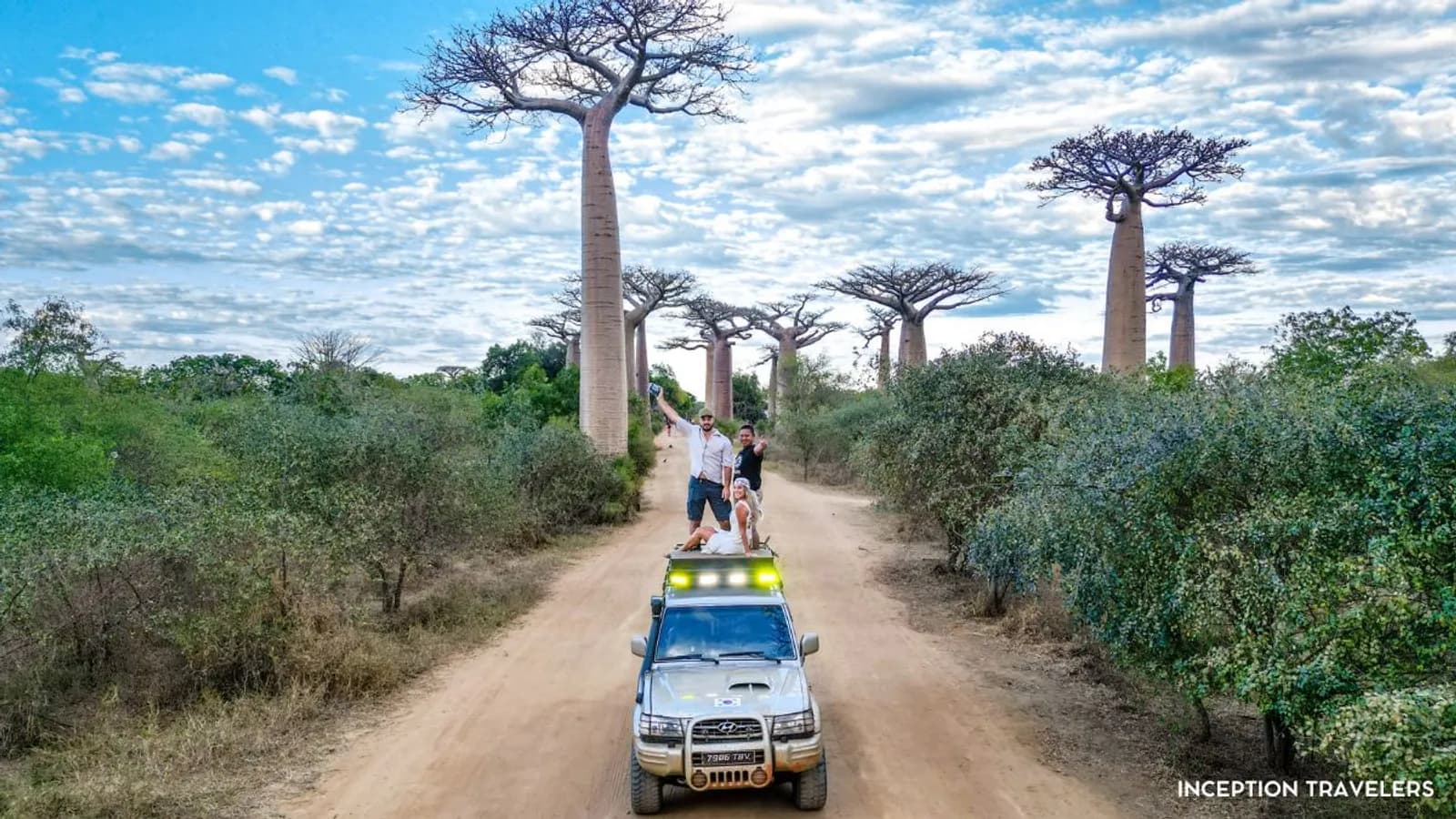
You time the drive so you reach the Avenue of the Baobabs for golden hour, and it lands exactly the way you hope.
The light goes orange, the trunks turn almost red, and the shadows stretch right across the dirt road. Photos of this place are everywhere, and somehow it still doesn't prepare you — they are enormous, and completely silent.
We walked the whole avenue slowly. Don't rush it. This is the picture you came to Madagascar for.
🌳 What You're Actually Looking At
These are Adansonia grandidieri — the biggest of Madagascar's baobabs, and found nowhere else in the world.
The thing most people don't realise: the avenue isn't a planted alley. These trees are what's left over from the dense forest that used to cover this whole area. The forest was cleared for farmland over the years and the baobabs were spared, so what looks like a designed avenue is really the last of something much bigger, standing in open fields.
They're old, too — centuries rather than decades. Worth thinking about while you're standing under one.
🥤 We Tried the Baobab Juice
You'll see it sold near the avenue, made from the fruit pulp.
Honest verdict? Not bad. But not the best thing we drank in Madagascar either 😅
Try it anyway — it's the kind of thing you'll be glad you did, even if you don't order a second one.
💡 Tips for This Day
- Accept that it's a travel day and settle in — the road is long
- Arrive well before sunset, not at it; you want time to walk the avenue first
- Golden hour is short. Have your camera ready before the light turns
- Go back to the hotel early — you'll be up before dawn tomorrow
🏡 Where We Stayed
Hotel Menabe, in Morondava — close enough to get back to the avenue for sunrise.
✅ Included: Baobab sunset stop (free).
Day 12: Morondava → Belo-sur-Mer (Sunrise Baobabs) 🚙
Up in the dark, back to the avenue. Again.
And yes — it was worth setting the alarm.
🌄 Sunrise at the Avenue
Sunset is the famous one, but sunrise is the one we'd tell you not to skip. The light is softer, the air is cool, and there are far fewer people — on a good morning, almost nobody.
Same trees, completely different mood. If you can only do one, we'd take the sunrise.
🚙 The Track South
After that it's another travel day, this time down the coast on rough tracks towards Belo-sur-Mer.
It's slow going, but the landscape keeps changing, and you can feel yourself getting properly off the map.
🏝️ Belo-sur-Mer
This place feels different from anywhere else on the trip.
It's a small coastal village with a long boatbuilding tradition — the Vezo here have been building wooden sailing boats on the beach by hand for generations, and you'll see hulls sitting out in the open in various stages of construction. No workshop, no machinery. Just wood, tools and the sea a few metres away.
🏡 Where We Stayed: Belo Beach
Calling it a resort would be generous — and honestly, that's the appeal.
It's an eco lodge, right on the sand. Some specifics so you know what you're booking:
- Steps from the beach — you can hear the water from bed
- Naturally heated water for the showers
- Simple, eco-minded, and run accordingly
- Don't come expecting maximum comfort — that isn't what this is
If you want a polished hotel, this will disappoint you. If you want to sleep on an empty stretch of Madagascan coast, it's close to perfect.
🏖️ We Had the Beach to Ourselves
Completely alone. Not quiet — alone.
We walked the beach in the afternoon and didn't see another person. In a world of crowded coastlines, that's genuinely rare, and it's the thing we remember most about Belo-sur-Mer.
Dinner, then an early night. 🌙
💡 Tips for This Day
- Do the sunrise — fewer people and better light than the evening before
- Pack the night before; you're leaving in the dark
- Adjust your expectations for Belo Beach and you'll love it
- Bring anything you specifically need — you're a long way from a shop
✅ Included: Baobab sunrise stop (free).
Day 13: Belo-sur-Mer → Andavadoaka (Laguna Blu) 🏖️
Another long drive south — and the best hotel of the entire trip waiting at the end of it.
🌵 South Through the Spiny Forest
The route runs on remote tracks through spiny forest and Vezo villages down to Andavadoaka.
The spiny forest is worth looking up from your phone for. It grows in the dry south-west of Madagascar and nowhere else on the planet: strange tall spined trunks, octopus-armed branches, everything built to survive with almost no rain. It looks less like a forest than like a landscape from another planet.
🎣 Andavadoaka
Andavadoaka is a Vezo fishing village on a beautiful stretch of coast.
The Vezo live from the sea here, and the area is known for community-run marine conservation — local villages manage their own fishing zones and reef reserves rather than having it imposed on them. It's one of the reasons the water here is in the state it's in.
🏡 Where We Stayed: Laguna Blu — the Best Hotel of the Trip
We stayed in a lot of places in a month. This was the best one, and it isn't close. 🏆
It's run by an Italian couple from Bologna, and it shows — in the care that's gone into the place, and especially in the kitchen.
- The setting is genuinely beautiful — this is the postcard stop of the trip
- The food is outstanding. Not "good for Madagascar" — properly, seriously good
- A pool and a swim waiting after hours in the car
- Warm, personal hosting rather than resort service
We arrived tired from the drive, went straight in for a swim, and spent the rest of the day doing very little. Exactly what was needed.
💡 Tips for This Day
- It's a long transfer — take snacks and water for the road
- Don't plan anything for the afternoon beyond arriving and swimming
- Eat at the hotel. Seriously
- If your itinerary is flexible, this is the place to add an extra night
🏡 Hotel: Laguna Blu — Resort Madagascar.
Day 14: Andavadoaka (Free Day)
Beach, snorkel, pirogue rides (18 eur pp), or just watch the colors of the Channel change by the hour.
Hotel: Laguna Blu - Resort Madagascar
Day 15: Andavadoaka → Ifaty (Mangily) 🌊
Coastal track to Ifaty; arrive late afternoon for an easy beach sunset.
Hotel: Vovo Telo Lodge
Days 16–17: Ifaty (Free Days)
Relaxation days. Optional: spiny forest sunrise walk, whale watching (seasonal), reef snorkel.
Hotel: Vovo Telo Lodge
Day 18: Ifaty → Toliara → Ranohira (Isalo) 🏜️
From the coast inland to Isalo. Scenic change from dunes to sandstone massifs.
Hotel: Isalo Ranch
Day 19: Isalo National Park (Natural Pools & Window of Isalo) 🌄
Full day hiking: Natural Pool, Black & Blue Pools, viewpoints, and Window of Isalo at sunset.
Hotel: Isalo Ranch
Included: Park entrance + local English-speaking guide, ask for "Roland" he's truly THE best.
Day 20: Ranohira → Ranomafana 🌧️
Early start to the cool, misty rainforest of Ranomafana. Long driving day.
Hotel: Forêt Austral
Day 21: Ranomafana National Park (Rainforest Wildlife) 🍃
Trails among rivers and waterfalls searching for golden bamboo lemur, chameleons, frogs, and endemics.
Hotel: Forêt Austral
Included: Park entrance + local guide.
Day 22: Ranomafana → Antsirabe
Back to the Highlands: rice terraces, brick kilns, and craft villages en route.
Hotel: Antsirabe Hotel
Day 23: Antsirabe (Tritriva Lake) → Antananarivo 🏞️
Morning visit to Lac Tritriva, then return to Tana. Overnight near the airport for easy logistics (recommended: Fly Inn Antananarivo with free shuttle).
Hotel: Fly Inn Antananarivo
Day 24: Flight to Nosy Be (Coin Sauvage) 🏝️
Domestic flight to Nosy Be (note: schedules often change). Check into Coin Sauvage. Explore and unwind.
Hotel: Coin Sauvage
Day 25: Lokobe Natural Reserve (Nosy Be) 🐾
Day inside Lokobe — primary forest, lemurs, and chameleons. Return to Coin Sauvage.
Hotel: Coin Sauvage
Days 26–27: Nosy Iranja Overnight (Bivouac) 🐢
Boat out at 07:00. Nosy Iranja is postcard-perfect; day activities + sandbar sunsets; bivouac under the stars. Return afternoon next day.
Included: Boat transfers, 2 lunches + 1 dinner + 1 breakfast, sunset aperitif, tuktuks, English-speaking guide. €170 pp (deposit €30).
Hotel: Chez Olivia
Day 28: Island Exploration & Scuba Course (Day 1)
Sacred tree, waterfalls, then Blue Wave Diving — pool/confined water + theory. €450 pp for certification (4 dives).
Hotel: Loharano Lodge
Day 29: Nosy Tanikely (Marine Park) 🤿
First open-water dive at Nosy Tanikely (marine park; ~€10 fee in 2025). Sunset at Mont Passot.
Hotel: Loharano Lodge
Day 30: Nosy Sakatia (Turtles) 🐢
Another island, another dive — Nosy Sakatia has abundant turtles (great even for snorkelers). Add-on beach lunch ~€40 pp.
Hotel: Loharano Lodge
Day 31: Tanikely (Final Dives) + Certification 🎉
Finish dives, exam, and certification. Move to Manga Soa Lodge for a change of scenery and relax.
Hotel: Loharano Lodge
Day 32: Manga Soa Lodge (Rest Day)
Chill day. Dinner in town (try Karibo); night out at Le Taxi Be.
Hotel: Manga Soa Lodge
Day 33: Hell-Ville Markets & Fly to Tana 🛫
Souvenirs in Hell-Ville (central market; tees/souvenirs at MAKI, and hidden-gem Art Village), then evening flight back to Tana. Note: lodge airport transfer quoted €20; tuk-tuk was ~€4.
Hotel: Fly Inn Antananarivo
Day 34: Antananarivo → Home
Leisure morning, last-minute shopping, then transfer to Ivato for the Emirates flight at 18:35. Veloma, Madagascar! 🇲🇬
What Was Included (TO Package)
- Private 4WD with fuel for the entire circuit + English-speaking driver (driver’s meals & accommodation covered)
- Tourist taxes
- Hotels in Miandrivazo, Bekopaka, Belo-sur-Mer (as per program)
- Local guides in national parks and reserves + all listed entrance fees
- Tsiribihina River: bivouac equipment (tent, mat), pirogue + piroguier, cook, bivouac assistant
- English-speaking guide in parks/reserves (as specified)
- Activities mentioned in this program
Practical Tips You Should Know ⭐
- Cash is king: ATMs can be scarce outside Tana/Toliara. Carry small Ariary notes for villages/tolls.
- Roads are slow: Even “short” distances can take hours. Start early and keep itineraries flexible.
- Dry bags & headlamp: Essential for the river descent and power cuts.
- Footwear: Closed shoes with grip for Tsingy/Isalo; reef shoes for islands.
- Respect local customs: Sacred sites (fady) are real — ask your guide before flying drones or entering certain areas.
- Domestic flights: Schedules change often — reconfirm times 24–48h before.
Conclusion: Wild, Remote, Unforgettable 🌟
From rainforest calls in Andasibe to starlit bivouacs on the Tsiribihina, from the sky-paths of the Tsingy to the orange glow of baobab sunsets and the turquoise bays of Nosy Be — South–West Madagascar is raw, remote, and utterly magical. If you crave the off-the-beaten-path, this route delivers a lifetime of stories.
Questions or want help tailoring this for your dates/budget? Write us at [email protected] — we’ll help you plan it right. 💌
Safe travels, and mora mora — take it slow, that’s how Madagascar shines. 🌅