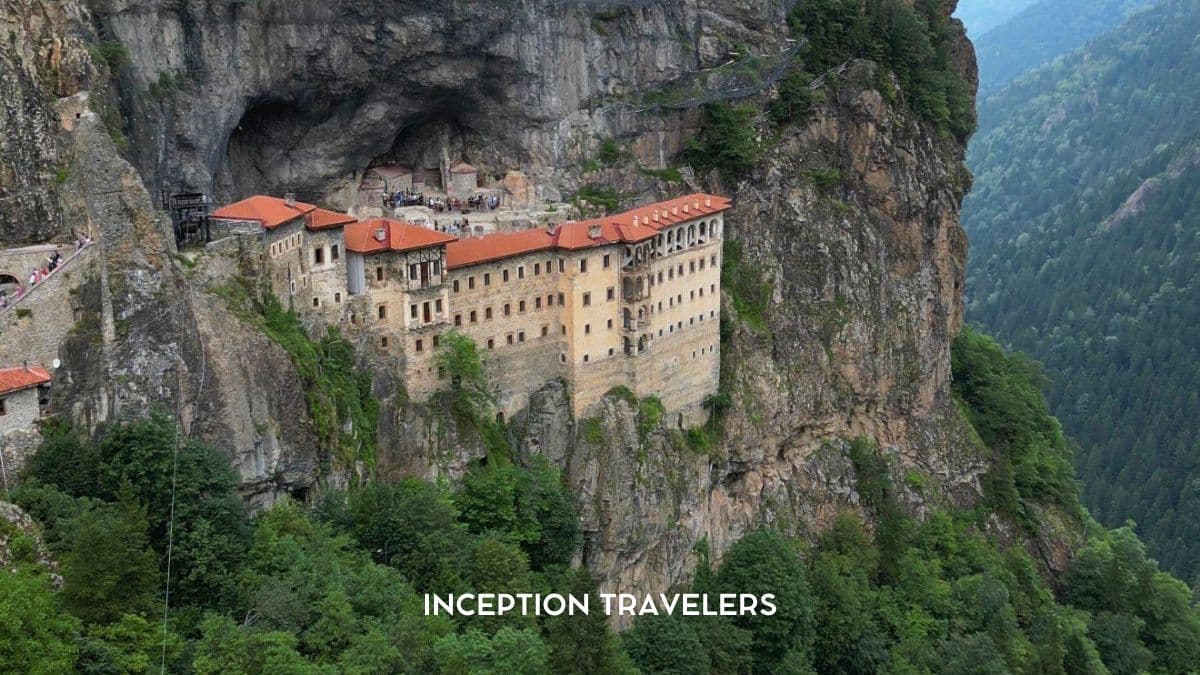
There is a moment on the road from Trabzon when the forest opens up and you see it: a pale stack of buildings glued to a vertical grey cliff, 300 metres above the valley floor, with nothing but pine trees and mist underneath. Everyone in the car goes quiet. Then someone asks the obvious question - how did anyone build that?
That's Sümela Monastery, and it's the single best reason to point your trip at Türkiye's Black Sea coast instead of the beaches everyone else flies to. This guide covers the legend, the history, exactly how to get there, what it costs, and the practical things nobody tells you until you're already sweating up the staircase.
Sümela Monastery at a glance
- Full name: Panagia Soumela / Sümela Manastırı, also known as Meryem Ana (Virgin Mary) Monastery
- Where: Altındere Valley National Park, Maçka district, Trabzon Province, Türkiye
- Distance from Trabzon: roughly 45–50 km, about an hour by car
- Altitude: around 1,150–1,200 m, built into the cliffs of Karadağ (Mount Mela)
- Founded: late 4th century AD, traditionally 386
- Status: state museum, on UNESCO's Tentative World Heritage List
- Opening hours: daily, typically 08:00–19:00 in summer with the ticket office closing at 18:30, and earlier in winter
- Time needed: 2–3 hours on site, half a day round trip from Trabzon
- Effort level: moderate — a forest path plus a long, narrow staircase
The legend: two monks, one dream, one icon
The story starts in Athens, at the end of the 4th century.
Two priests, Barnabas and Sophronios, are said to have had the same dream on the same night. The Virgin Mary appeared to each of them and told them where to find a sacred icon — one supposedly painted by Saint Luke the Evangelist himself, and carried by angels from Athens to a cave in the mountains of Pontus, high above the Black Sea.
The two monks travelled separately, neither knowing the other was on the road. They arrived in Trabzon, climbed into the mountains, and found each other at the same cave — with the icon inside it, exactly as described. They walled up the mouth of the cave, built a church in front of it, and that cave church is still the beating heart of the complex today.
The name carries the legend too. Mela was the old name of the mountain, from the Greek melas, meaning black. Stou Mela — "at Mela" — becomes Soumela, Sümela. The Black Mountain monastery.
Whether you believe the angels or not, the choice of site makes a strange kind of sense: a cave with a natural spring, invisible from below, defensible, and staggeringly beautiful. Monks have been choosing places like this for sixteen centuries.
The history, in the order it happened
Late 4th century (traditionally 386). Foundations laid during the reign of Byzantine Emperor Theodosius I. What exists at this stage is essentially the cave church.
14th century — the golden age. The monastery's real patron is Alexios III Komnenos (1349–1390), emperor of Trebizond, whose portrait and imperial grants appear in the frescoes. Under the Komnenos dynasty, Sümela becomes rich, powerful, and a major pilgrimage site for the Greeks of the Black Sea.
1461 onwards — the Ottomans arrive. This is the part that surprises people. After Mehmet the Conqueror took Trabzon, Sümela's rights were preserved rather than abolished. Mehmet II issued an edict that the monastery was not to be touched and should continue its activities. Selim I later presented it with two large candles. Successive sultans confirmed its privileges by firman, and the monastery ran continuously through the Ottoman centuries.
18th–19th centuries — the peak. Large sections are rebuilt, the frescoes are renewed, and new buildings go up. By the 1800s the complex has a library, guest houses, a kitchen, dozens of monks' cells, an aqueduct, and a multi-storey block hanging over the drop.
1923 — the end of monastic life. With the population exchange between Türkiye and Greece, the monks leave. Before going, they bury the icon and the monastery's sacred objects near the Chapel of St. Barbara.
1931 — the icon leaves. Following a meeting between Greek Prime Minister Eleftherios Venizelos and Turkish Prime Minister İsmet İnönü, permission is granted to retrieve them. One of the monks who buried the icon returns to recover it, and the treasures are taken to the Benaki Museum in Athens.
1952 — a new Soumela. A new Panagia Soumela monastery is built in Veria, northern Greece, and the icon is moved there. It remains one of the most important pilgrimage sites for Pontic Greeks worldwide.
2010 — the first liturgy in 88 years. Ecumenical Patriarch Bartholomew celebrates the Divine Liturgy at Sümela on 15 August, the first service held there since 1923.
2015–2019 — the great restoration. The site closes for major works: aqueducts restored, the staircase rebuilt, and roughly 4,000 tonnes of unstable rock cleared from the cliff face above, plus a 300-metre walkway laid out. The work uncovers things nobody expected — a chapel reached by a secret passage, frescoes depicting Heaven and Hell and Death and Life, an "Ordeal Room", and a lookout chapel that served as an outpost.
Since then. The monastery has reopened in stages, with more sections and upper levels released to the public as conservation continues. Individual rooms and paths can still be closed at short notice.
What you'll actually see
The rock church. The original cave, walled in at the front. Both the interior and exterior walls are covered in frescoes — the outer wall facing the courtyard carries work from the Alexios III era, while the adjacent chapel's paintings date from the early 18th century. The subjects are biblical: the life of Christ, the life of the Virgin, angels, apostles, the Last Judgement.
The frescoes themselves. Be honest with yourself before you go: there is graffiti. Decades of abandonment left names scratched across saints' faces, and treasure hunters did real damage. It's part of the site's story now. What survives is still extraordinary, especially where 18th-century painting sits directly over Byzantine work.
The inner courtyard and monks' quarters. Cells, cupboards, hearths and niches, several showing clear Ottoman-Turkish influence in their design. The big balconied block on the cliff face was the dormitory and guest house.
The ayazma. The sacred spring, credited with healing powers, and one of the practical reasons this site could sustain a community at all.
The kitchen, library and student rooms. Sümela wasn't just a church. It was a training centre for monks, with real infrastructure behind it.
The Chapel of St. Barbara. Sitting at the end of the drive, at the edge of the cliff. Historically the women's monastery, and today one of the best places to photograph the main complex from across the valley.
The view back down. From the balconies, the Altındere Valley drops away into forest. On a misty morning the cloud sits below you.
How to get to Sümela Monastery
Everything starts in Trabzon, on the Black Sea coast. Trabzon Airport (TZX) has frequent flights from Istanbul, around 1h45, plus connections from Ankara, İzmir and several international cities.
From Trabzon the route is the same for everyone: head south through Maçka, then into Altındere Valley National Park. You cannot drive to the monastery door. You drive up to a designated point, then continue on foot along a forest path of roughly 300 metres, and finish with a narrow staircase to the entrance.
Option 1 — Organised day tour (easiest)
The most common choice, and honestly the most sensible if you're short on time. Standard tours run 6–9 hours from Trabzon and usually bundle Sümela with Hamsiköy (the mountain village famous for its rice pudding), Zigana Pass, or Karaca Cave. Longer versions add Uzungöl lake, which makes for a very long day.
Expect roughly €35–90 per person for a shared group tour, more for private. Check carefully whether the monastery entrance and the park shuttle are included — very often they are not.
AFFILIATE BLOCK: GetYourGuide widget — "Sümela Monastery day tours from Trabzon"
Option 2 — Rental car or taxi
The most flexible option and a beautiful drive. Follow the E97/D885 south from Trabzon through Maçka, then the signs for Altındere Vadisi Milli Parkı. Allow one to one and a half hours each way. The final stretch is winding mountain road — fine in good conditions, less fun in rain or fog.
For a taxi, agree the full round-trip price and the waiting time before you set off. You don't want to be negotiating a return fare at 1,200 metres.
AFFILIATE BLOCK: car rental / private transfer widget
Option 3 — Public transport (cheapest)
There's no single direct bus from central Trabzon to the monastery.
- Take a dolmuş (shared minibus) from Trabzon to Maçka, around 45 minutes.
- From Maçka, continue by local dolmuş or taxi to the national park entrance, 15–20 minutes.
- Inside the park, transfer to the shuttle up toward the monastery, then walk the final stretch.
In peak summer there are sometimes direct seasonal dolmuşes from Trabzon, but frequency changes from year to year. Budget two to three hours each way and start early — the last thing you want is to be waiting on a return dolmuş that has stopped running for the day.
The last stretch
However you arrive: park shuttle, then a 300-metre forest path, then a narrow staircase. Shuttle and parking arrangements inside the national park change with the season and visitor numbers, and the shuttle is normally paid separately from your museum ticket. Follow the signs and staff instructions on the day rather than a timetable you found on a forum.
Tickets, opening hours and practical info
Opening hours. The monastery is open every day of the week. The summer schedule is typically 08:00–19:00 with the ticket office closing at 18:30, and closing is earlier in winter, usually around 17:00 with the ticket office shutting at 16:30. Seasons change over on roughly the same dates each year, but confirm before you travel.
Tickets. Prices are set by the Ministry of Culture and Tourism and have been revised repeatedly, so any figure you find quoted online is likely out of date. Check or buy on the official portal, muze.gov.tr, shortly before your visit. Two things worth knowing:
- MüzeKart, the Turkish museum pass, is valid here for Turkish citizens.
- The national park entrance, parking and shuttle may be charged separately from the museum ticket. Don't assume one price covers everything.
Partial closures. Sümela has been under near-continuous conservation for years, and the official listing has at times flagged parts of the site as closed while rock-stabilisation and restoration work continues. The visit is absolutely worth doing regardless, but if there's one specific chapel or fresco you're travelling for, verify access first.
How long to allow. Two to three hours on site is comfortable. Half a day including the drive from Trabzon.
Fitness and accessibility. The forest path plus the staircase makes this unsuitable for wheelchairs and strollers, and genuinely challenging if you have knee or mobility issues. There's no way around the stairs — they're the only entrance.
What to wear. Proper shoes with grip, because the stone gets slippery when wet and it's wet often. Layers: it can be ten degrees cooler than the coast. A light rain jacket, even in August. As a site of religious significance, modest dress with covered shoulders and knees is respectful.
Facilities. Cafés, restaurants and toilets sit at the base of the site near the car park. There's very little once you're up. Bring water.
The best time to visit
May to October is the reliable window. Roads are clear, the valley is aggressively green, and the full site is normally accessible.
- June to September — warmest and busiest. Tour buses arrive mid-morning.
- May, and late September into October — the sweet spot. Fewer crowds, softer light, autumn colour in the valley.
- Winter — magical if the snow is behaving, but access can be affected by weather, hours are shorter, and the mountain road demands respect.
Go early. The 08:00 opening is your friend. You get the first hour nearly alone, the morning mist in the valley, and no queue on the staircase. By 11:00 the day tours from Trabzon have all landed.
About the fog. The Black Sea coast is genuinely one of the wettest regions in Türkiye, and cloud can swallow the whole cliff for hours. It's frustrating for photos and spectacular for atmosphere. If you have flexibility, keep a buffer day.
The August liturgy
One religious service a year is permitted at Sümela: the Divine Liturgy for the Feast of the Dormition of the Theotokos, historically on 15 August. It resumed in 2010 after an 88-year gap, and it's an emotional occasion for Pontic Greeks who travel in from Greece, Georgia and beyond. Attendance is limited and requires a pass issued by the Ecumenical Patriarchate of Constantinople, so it isn't something you can turn up to as a tourist.
Permission is granted year by year and has been contested. In some years authorities have not authorised the service on 15 August itself, and it has been held later in the month instead, on the Apodosis of the Feast. If you're planning around it, follow announcements from the Patriarchate rather than assuming a fixed date.
For everyone else, note that mid-August is peak season regardless. Expect crowds.
Make it a full trip: what else to see nearby
- Hamsiköy — the mountain village on the old road, and the undisputed home of Turkish sütlaç, rice pudding. Almost every tour stops here, for good reason.
- Zigana Pass — high mountain scenery on the historic route inland toward Gümüşhane.
- Karaca Cave — stalactites and stalagmites, an easy add-on.
- Uzungöl — the alpine lake ringed by wooden houses. Beautiful, extremely popular, and a long way from Sümela. Give it its own day if you can.
- Hagia Sophia of Trabzon — 13th-century Komnenian church with superb frescoes, back in the city.
- Atatürk Pavilion and Boztepe Hill — for the classic view over Trabzon and the sea.
A sensible three days based in Trabzon:
- Day 1 — Trabzon city: Hagia Sophia, Atatürk Pavilion, Boztepe, the old bazaar.
- Day 2 — Sümela early, Hamsiköy for lunch, Karaca Cave or Zigana on the way back.
- Day 3 — Uzungöl and the highland plateaus.
AFFILIATE BLOCK: Booking.com — hotels in Trabzon and Maçka
Where to stay
Trabzon city is the practical base, with the best hotel range, the restaurants and the airport. About an hour from the monastery.
Maçka and Hamsiköy put you far closer for a dawn arrival, with small guesthouses, bungalows and stone hotels in the mountains. If your priority is being at the gate at opening with the valley to yourself, staying up here is the move.
Photography tips
- The classic shot — the whole complex on the cliff — is taken from the approach trail and from near the St. Barbara chapelviewpoint, not from inside the monastery.
- Morning light hits the cliff face better, and morning mist in the valley is what makes the photo.
- Bring a wide lens for the interior. The courtyard is tight and the frescoes run floor to ceiling.
- Protect your gear. Humidity is high and rain arrives without warning.
- A drone is not a given. Türkiye's drone rules are strict, and this is both a protected heritage site and a national park. Don't assume, check permissions.
Is it worth it?
Yes, with one caveat. If you arrive at midday in August expecting serene monastic silence, you'll get a queue on a staircase instead. Arrive at opening, take the forest path slowly, and sit on the balcony above the valley before the buses come. Sümela is one of the most extraordinary places in Türkiye. Not a ruin you tick off, but a place that makes you wonder what people are capable of when they really believe something.
Frequently asked questions
Where is Sümela Monastery?
In Altındere Valley National Park, in the Maçka district of Trabzon Province, on Türkiye's eastern Black Sea coast. It's roughly 45–50 km south of Trabzon city centre, about an hour by car.
How old is Sümela Monastery?
The foundations date to the late 4th century AD, traditionally 386, during the reign of Byzantine Emperor Theodosius I. That makes it around 1,600 years old, though most of what stands today is from the 14th century onwards, with major 18th and 19th-century rebuilding.
Why was Sümela Monastery built on a cliff?
The legend says two Athenian monks were directed to a specific cave by the Virgin Mary in a dream, where they found an icon painted by Saint Luke. Practically, the site offered a cave, a natural spring, isolation from the world and near-total defensibility.
What does "Sümela" mean?
It comes from the Greek melas, meaning "black". The old name of the mountain was Mela, and Stou Mela, "at Mela", became Soumela. In Turkish it's also known as Meryem Ana Manastırı, the Monastery of the Virgin Mary.
Is Sümela Monastery open to visitors?
Yes, it's open daily as a state museum. Conservation work has continued for years, and individual rooms, chapels or paths can be closed at short notice, so check the official muze.gov.tr listing before you travel.
How much does it cost to enter Sümela Monastery?
Admission is set by the Ministry of Culture and Tourism and has changed repeatedly, so check the official portal rather than older blog posts. MüzeKart is valid for Turkish citizens. Note that national park entry, parking and the shuttle can be charged separately.
Can you drive all the way to the monastery?
No. You drive up to a designated point inside the national park, then continue by shuttle and on foot, about 300 metres through the forest, followed by a narrow staircase to the entrance.
How long does it take to walk up to Sümela?
From the drop-off point, roughly 15–20 minutes on the forest path, plus the staircase. It's uphill and uneven, but manageable for most reasonably fit visitors.
Is Sümela Monastery wheelchair accessible?
No. The forest path and the long, narrow staircase make it unsuitable for wheelchairs and strollers, and difficult for anyone with significant mobility limitations.
How long should I spend at Sümela Monastery?
Two to three hours on site is comfortable, or about half a day including the round trip from Trabzon.
What's the best time of day to visit?
Right at opening. You avoid the tour buses that arrive mid-morning, catch the mist in the valley, and get the frescoes largely to yourself.
Can I attend a religious service at Sümela?
Only one service is permitted per year, the Divine Liturgy for the Dormition of the Theotokos in August, and attendance requires a pass from the Ecumenical Patriarchate. It's not open to walk-in visitors.
Is Sümela Monastery a UNESCO World Heritage Site?
It's on UNESCO's Tentative List of World Cultural Heritage, added in 2000. It has not yet been inscribed on the main list.
Is Trabzon worth visiting beyond the monastery?
Definitely. Hagia Sophia of Trabzon, Boztepe Hill, Uzungöl lake, Hamsiköy, Zigana Pass and the highland plateaus make an easy three or four day trip, and the food along this coast — anchovies, corn bread, black cabbage, mountain butter — is unlike anywhere else in Türkiye.
Have you been to Sümela? Tell us what the valley looked like on your day. We've had it both ways, blazing clear and completely swallowed by cloud.